How I Conquered Rheumatoid Arthritis – Part 6
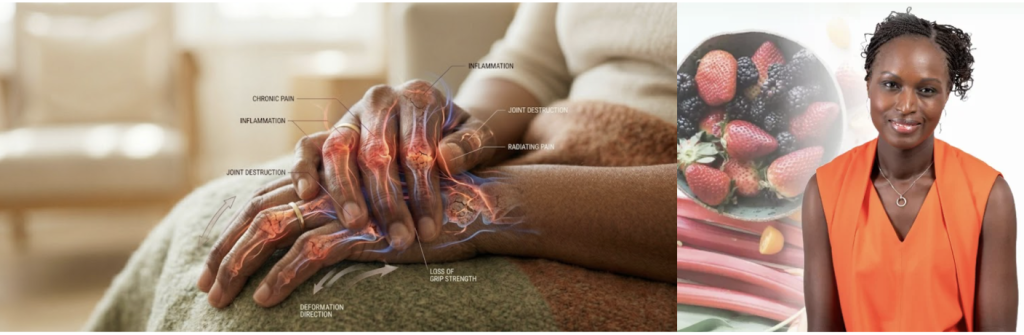
I was back home in Hong Kong after my business trip to New York, and I was determined to heal. I did not know how, but I was going to search and find a way, because I could not accept the prospect of no longer having a normal life. And above all, I was in pain: the slightest brush against my swollen fingers made me want to scream.
My husband and children struggled to understand and anticipate which way of touching me would cause pain, because rheumatoid arthritis is invisible at first, as long as there are no visible deformities.
I still remember the firm handshake of a colleague I had just met at the office. I had to stifle a cry. Once he left, I could let out the pain he had caused (without meaning to, of course) that I was feeling in my fingers.
As I mentioned in part 3, I had already started making many dietary changes. I was constantly looking for which foods were good for my health so I could incorporate them into my diet. I snacked on fruits like blueberries and raspberries, and I started my mornings with a chia seed and fruit yoghurt. Yet my condition was not improving.
I kept researching, and one day I came across a video of a woman from the sattvic movement who was explaining, along with her husband, how they had both healed their chronic conditions through diet. She had previously suffered from thyroid problems, weight issues and acne, and her husband had skin problems.
She explained that the body is like a glass vase: if the vase is dirty on the inside, you can clean the outside as many times as you want; it will always stay dirty. You have to address the inside. And when the inside becomes clean, the outside becomes clean too.
She and her husband had completely changed their diet, and it was thanks to that change that they no longer had their chronic conditions and had regained full health.
I was very interested. This woman explained that some everyday foods, like seed oils, sunflower oil, rapeseed oil, peanut oil, etc., were actually very bad for your health.
Indeed, these oils are made by heating seeds at very high temperatures to extract the oil. Then, because the oil produced by this process is very dark and smells bad, the equivalent of bleaching agents and deodorants are added to make it presentable. That is what gives us these clear, odourless oils on supermarket shelves¹.
These oils are factually bad for your health. And to understand their effect on our body, we need to understand what our cells are made of. That is what I was about to learn as I continued my research, particularly through the work of doctors who had themselves developed chronic conditions, including autoimmune diseases, and had managed to heal by turning to functional medicine and completely changing the way they ate.
It is truly these doctors, and the knowledge they shared, that helped me heal. French doctors such as Dr Seignalet with his book “Food or the Third Medicine“, and American doctors too, all contributed by sharing their knowledge and gave me the keys to my recovery, along with the passion to deepen this field to the point of making it my career.
So let us come back to oils and their harmful effects on our health at the deepest level. To understand, we need to go back to biology. Our body is made up of systems, which are made up of organs, which are themselves made up of tissues, which are themselves made up of cells. The cell is the smallest biological unit of our body, and our body contains approximately 30 trillion of them.
Each cell has a well-defined composition to carry out tasks essential to our survival: absorbing nutrients, producing energy, synthesising other molecules, excreting toxins, and replicating for our growth and maintenance.
Our cell membranes play a key role in these functions, because it is through them that all exchanges take place. These membranes are made up of lipids (fats) and proteins. When these lipids and proteins are of good quality and in sufficient supply, the membranes are supple and flexible, which facilitates all these exchanges and allows the body to absorb nutrients and detoxify.
The problem with seed oils is that they provide poor-quality fats that the body uses, for lack of anything better, to build its cells. These fats are harmful because they do not exist in nature: they were created by humans to reduce production costs and extend the shelf life of industrial food products.
The effect of these fats is harmful: they stiffen our cell membranes, making them rigid and unable to facilitate the exchange of nutrients, waste products, and general communication between our cells. And that is where the problems begin². Indeed, an excess of omega-6, which these oils are very high in, creates inflammation in the body, and this inflammation predisposes us to chronic diseases, particularly cardiovascular disease and autoimmune conditions³˒⁴.
These oils are, in fact, a clear example of what we call ultra-processed foods.

You might be thinking: no problem, I only cook with olive oil.
But be careful: if you eat out often, if you buy ready meals, shop-bought biscuits or cakes, you are ingesting these oils. They are present in almost all industrial food products: crisps, cookies, breakfast cereals, popcorn, mayonnaise, burgers, pizzas, frozen chips, ready meals, margarines, unless stated otherwise on the label.
I am not saying this to discourage you from eating out, but to raise your awareness so that you can make the right choices for what you control, particularly at home, and also in the products you buy at the supermarket.
These oils and industrial food products are high in omega-6 and contain virtually no omega-3, which creates an imbalance in our body. In reality, we need both types of these essential fatty acids (omega-3 and omega-6) that our body cannot produce on its own, and which we must therefore obtain through our diet. Omega-6 is linoleic acid, and omega-3 is alpha-linolenic acid.
As human beings, we evolved eating a diet with an omega-6 to omega-3 ratio of 1 to 1. This has changed dramatically over the past century, with omega-6 consumption rising steadily. Unfortunately, in the Western world today, this ratio has shifted to 16 to 1, which is a significant imbalance³.
This is due to the consumption of seed oils high in omega-6, but also to the consumption of meat from animals fed on grains rather than grass, and from dairy products from those same animals.
Omega-3 fatty acids are found in nuts and seeds, such as flaxseeds, pumpkin seeds and chia seeds, but also in oily fish such as sardines, salmon, mackerel and herring, which are among the least contaminated with mercury.
When we flood our body with omega-6, it has no choice but to use this type of fatty acid to build its cells, resulting in cells that function poorly.
An imbalance in fatty acids can contribute to many conditions: dry skin and eyes, hormonal problems, obesity, menstrual disorders, elevated insulin, infertility, cysts, circulation problems, and immune or neurological issues. Because an excess of omega-6 generates inflammation, which lies at the root of every chronic disease.
When I discovered all of this, I never used seed oil again. I made sure to buy only quality, cold-pressed oils: olive oil, avocado oil, flaxseed oil and coconut oil.
If you have seed oils in your kitchen, I encourage you to replace them with the oils I have just mentioned. Your body will thank you.
That is what I realised that day: the changes I had already started were not enough, not because they were wrong, but because I did not yet know everything that needed to be eliminated.
Seed oils were my first major wake-up call, but it was just the beginning of many changes that were about to transform my life and the lives of those close to me.
In part 7, I will talk about the other foods I used to eat thinking I was making healthy choices, which were actually fuelling my inflammation, as well as the mindset and lifestyle changes that made my healing possible, or rather, should I say, my remission, my return to full health?
Why do I use the word remission? Because I absolutely do not want to give the impression that this was some kind of miracle pill. No, I had to make many changes, and it was not always easy, especially in the beginning. And I know that if tomorrow I go back to the lifestyle I had before getting ill, not just a different diet, but the mindset and daily habits I had at the time, it is very possible that the rheumatoid arthritis and the other autoimmune conditions I had would eventually come back.
Chronic disease occurs when the body is no longer in balance, and when you give your body the means to restore that balance, the disease disappears. This discovery changed my entire life.
I will tell you more in part 7.
References
¹ Matthäus, B. and Guillaume, C. (2022) ‘Refining Vegetable Oils: Chemical and Physical Refining’, Scientific World Journal, 2022. Available at: https://pmc.ncbi.nlm.nih.gov/articles/PMC8767382/ (Accessed: June 2026).
² Oteng, A.B. and Kersten, S. (2020) ‘Mechanisms of Action of trans Fatty Acids’, Advances in Nutrition, 11(3), pp. 697–708. Available at: https://pmc.ncbi.nlm.nih.gov/articles/PMC7231579/ (Accessed: June 2026).
³ Simopoulos, A.P. (2008) ‘The importance of the omega-6/omega-3 fatty acid ratio in cardiovascular disease and other chronic diseases’, Experimental Biology and Medicine, 233(6), pp. 674–688. Available at: https://pubmed.ncbi.nlm.nih.gov/18408140/ (Accessed: June 2026).
⁴ Simopoulos, A.P. (2021) ‘The Importance of Maintaining a Low Omega-6/Omega-3 Ratio for Reducing the Risk of Autoimmune Diseases, Asthma, and Allergies’, Missouri Medicine, 118(5), pp. 453–459. Available at: https://pmc.ncbi.nlm.nih.gov/articles/PMC8504498/ (Accessed: June 2026).

FREE
Book your free clarity call
A 1-hour conversation where I take the time to understand your current health situation, get clear on your health objectives, and share what's your smartest next steps to improve your health.
This article is for educational purposes only and is not a substitute for personalised medical advice. Please consult a qualified healthcare practitioner before making changes to your diet, supplements, or lifestyle, especially if you are pregnant, breastfeeding, or managing a medical condition.