How I Conquered Rheumatoid Arthritis – Part 4
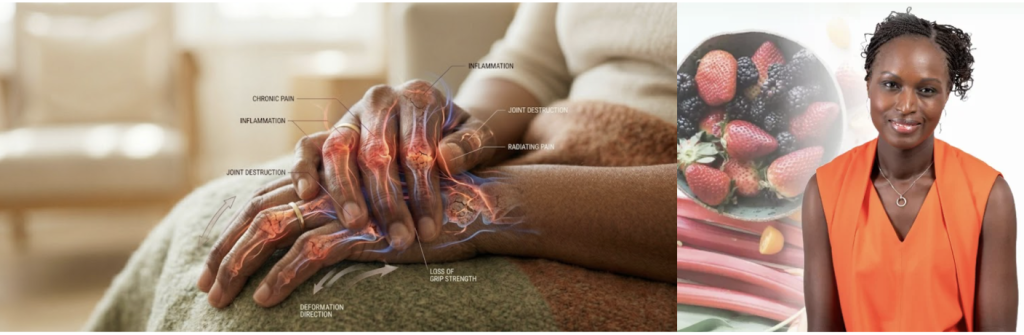
In February 2024, when I was diagnosed with rheumatoid arthritis (which I described in my first article) and realized that I needed to find my own way through it, there were many ups and downs.
Following the methotrexate treatment and its very harsh effects on my body, I implored my doctor to wait for one more month before starting the immunosuppressants I was supposed to take. I asked him to let me try to reduce the inflammation naturally.
I explained to him that it had worked in the past with Graves’ disease, that I had been able to control my hyperthyroidism through dietary changes. Indeed, even though I had not managed to maintain certain dietary changes in the long term, I had experienced their benefits on my health every time I had made the effort. I therefore really wanted to believe that diet could help with rheumatoid arthritis too.
He looked at me, surprised, and said: “You can try, but for this disease it won’t make any difference. You will need to come back for regular blood tests, because your inflammation may continue to increase, and if it does, you risk developing deformities.”
I was perfectly willing to come back for regular testing. On the contrary, it reassured me, because I was crazy: I knew the risks if the inflammation kept increasing. My rheumatologist had shown me everything at our very first appointment, with that book of photographs of deformed hands and limbs that I will never forget.
My fingers were already very painful, and so was my knee.
I immediately made an appointment with the naturopath who had helped me with Graves’ disease before, even though I had not managed to follow his advice in the long term.
I explained the situation to him, and he immediately gave me recommendations along with various supplements to help reduce inflammation in a more natural way and support my immune system. In total, I had four or five supplements to take every day.
My naturopath also immediately asked me to stop all animal products and switch to a vegan diet, to avoid gluten, and suggested that I take a microbiome test as well as a food intolerance test to better understand what might be at the root of my autoimmunity. I agreed, even though it was a significant expense.
The tests revealed surprising intolerances I had not had before, such as an intolerance to egg whites, even though I had never been aware of such an intolerance and had never had any problem after eating eggs. The tests also confirmed an intolerance to all cow’s milk products, which was not a surprise: my naturopath had explained that as adults, we no longer have the necessary enzymes (lactase) to digest milk, as we are no longer meant to drink it. Asian and African populations in particular are largely lactose intolerant.¹
My microbiome test also showed a very low level of short-chain fatty acids. I had absolutely no idea what that meant at the time. I would later learn that it was indicative of an imbalance in my gut microbiome, and in particular a lack of fibre. It is in fact the fibre we ingest that feeds the good bacteria in our microbiome. These good bacteria in turn, ferment the fibre in the colon to produce short-chain fatty acids such as butyrate, acetate and propionate. These short-chain fatty acids are critical for gut health: they regenerate the intestinal lining, support the production of intestinal mucus, and reduce inflammation. A lack of short-chain fatty acids signals inflammation in the digestive system and is a precursor to metabolic disorders (diabetes, obesity, etc.)² and mood or neurological disorders.³
In addition to the dietary supplements, I had to follow a strictly vegan diet as recommended by my naturopath.
I was motivated to get better, but I had very little knowledge of nutrition. To me, vegan simply meant vegetables only. I started following this diet without realising I was doing it the wrong way!
After a few days, I felt quite weak. I had lost a lot of weight and felt as though I was on the verge of fainting during my evening conference calls, even sitting in my office chair. I was still living in Hong Kong and had many evening meetings with the United States, which was really difficult.
When I went to see my naturopath and explained what had happened to me, he was surprised and explained that, of course, vegan did not mean carbohydrate-free. I needed carbohydrates for energy, and I also had to eat healthy grains such as brown rice, quinoa, buckwheat, and so on.
I adjusted my diet accordingly. But at that time, I was trying to cook a special meal for myself and a separate meal for my husband and the children, because after all, they were not ill; that was how I was thinking at the time.
Without realising it, I had added extra constraints for myself that generated a great deal of frustration. I was tired of having to prepare different meals (and thankfully at the time I had the help of a nanny).
To be honest, I was quite frustrated watching my family eat things they enjoyed, while I did not enjoy what I was eating at all during that period. I found my food bland and ate out of fear of the disease, rather than for pleasure.
Even though I did not enjoy what I was eating, I was making an enormous effort on my diet, because I wanted to get better. I kept imagining the scene where I would go back to see my rheumatologist and, looking at my latest blood results, he would say: “What have you done? All your inflammation markers have disappeared!” I thought about that constantly. At that time, even though I still had Graves’ disease and Sjögren’s syndrome on top of the rheumatoid arthritis, it was the rheumatoid arthritis that was ruining my life and that I wanted to get rid of at all costs, as a priority.
At the same time, I was doing so much research on what to eat to reduce inflammation that I was also adding all foods reputed to be “healthy,” such as blueberries, raspberries, and so on. I was following every trend I came across: on blogs, YouTube videos from certain “healthy” influencers. I was truly lost; I can say that in hindsight.
After a month, it was time for my follow-up with my rheumatologist. I had to have a blood test as agreed, to monitor how my condition was progressing. I was dreading that moment. My fingers still hurt, and often my shoulders and wrists too, which was not a good sign, but I was still hoping that the results would confirm a reduction in my inflammation and that I would be allowed to continue my dietary efforts without the immunosuppressants.
Unfortunately, that appointment did not go as I had hoped. My rheumatologist informed me that my inflammation markers had in fact increased and that I needed to start the treatment. I was devastated and so angry (even though I didn’t show it). How could I have made all that effort over the past weeks only to get an even worse result than the month before? I felt an overwhelming sense of injustice. I was not going to be able to avoid the methotrexate treatment after all…
In the meantime, life went on, with its family and professional responsibilities. At the very moment I had been diagnosed with rheumatoid arthritis, and my health had collapsed, I had been promoted at the same time. I had just been given the position I had been working towards. Many people were congratulating me on my professional success, not knowing that personally, in terms of my health, it was a descent into hell.
As part of my new responsibilities, I had to travel to the United States for a team seminar. I was a little apprehensive because of my illness, and at the same time I was looking forward to the trip as a great start to my new role. It was therefore an important journey.
Unfortunately, that trip did not go as planned. I would once again be confronted with the reality of my illness and the fact that even something as simple as a dinner at a restaurant with colleagues was no longer without consequences for me. That trip would end in a very painful and sad return home.
This is what I will tell you in Part 5.
References
1Itan, Y., Jones, B.L., Ingram, C.J.E., Swallow, D.M. and Thomas, M.G. (2010) ‘A worldwide correlation of lactase persistence phenotype and genotypes’, BMC Evolutionary Biology, 10(36). Available at: https://pmc.ncbi.nlm.nih.gov/articles/PMC2834688/
2Du, Y., He, C., An, Y., Huang, Y., Zhang, H., Fu, W., Wang, M., Shan, Z., Xie, J., Yang, Y. and Zhao, B. (2024) ‘The role of short-chain fatty acids in inflammation and body health’, International Journal of Molecular Sciences, 25(13). Available at:https://pmc.ncbi.nlm.nih.gov/articles/PMC11242198/
3 Zhang, R., Wang, R., Wu, H., Huang, Z., Liang, J., Zhang, R., Jiang, F. and Song, Y. (2025) ‘Gut microbiota as a novel target for treating anxiety and depression: from mechanisms to multimodal interventions’, Frontiers in Microbiology, 16. Available at:https://www.frontiersin.org/journals/microbiology/articles/10.3389/fmicb.2025.1664800/full

FREE
Book your free clarity call
A 1-hour conversation where I take the time to understand your current health situation, get clear on your health objectives, and share what's your smartest next steps to improve your health.
This article is for educational purposes only and is not a substitute for personalised medical advice. Please consult a qualified healthcare practitioner before making changes to your diet, supplements, or lifestyle, especially if you are pregnant, breastfeeding, or managing a medical condition.